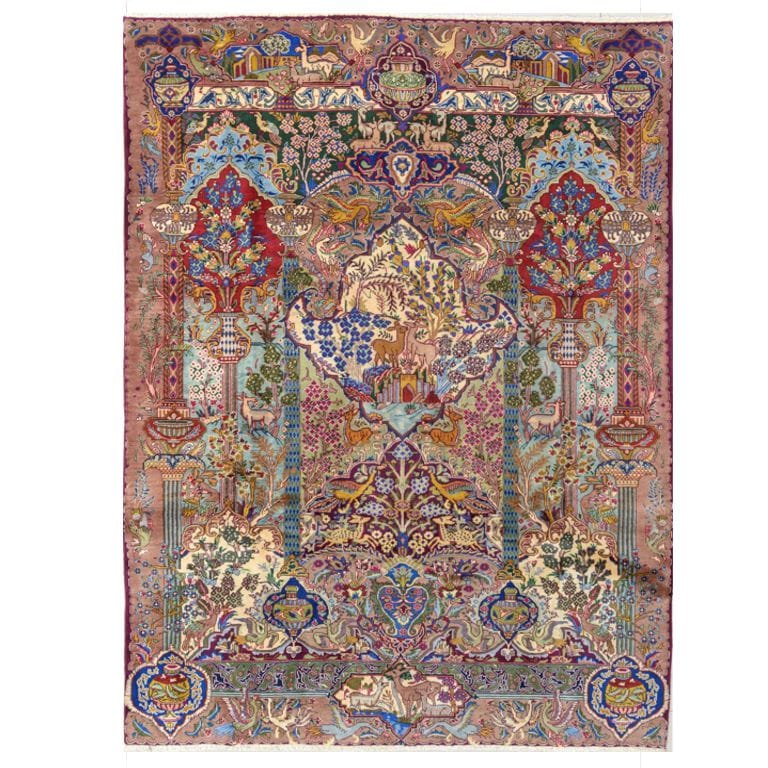
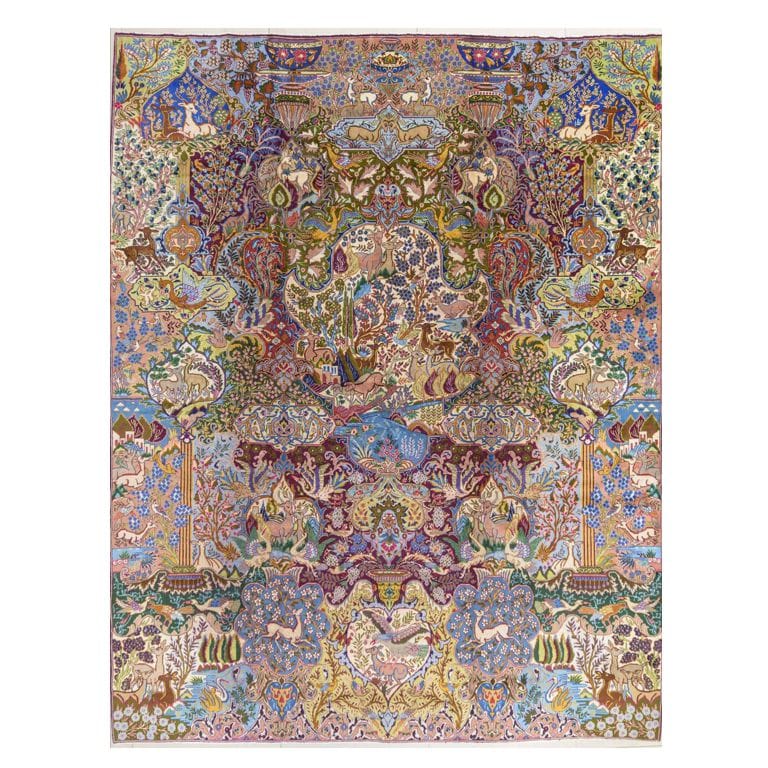
KASHMAR Persian carpets are rare narrative artworks from Iran’s Khorasan province, a historic Silk Road crossroads.
This location exposed weavers to a fusion of Zoroastrian, Buddhist, Hindu, and Islamic ideas, which they expressed in their designs.
In the late 19th century, increased contact with European art, a rising merchant class commissioning status symbols and higher knot counts Persian enabled a shift from the traditional geometric patterns..
In contrast to the traditional designs emphasizing abstract motifs in balanced, symmetrical compositions, weavers in the Khorasan province began depicting pictoral scenes from history, poetry and religion, turning the loom into a storytelling canvas.
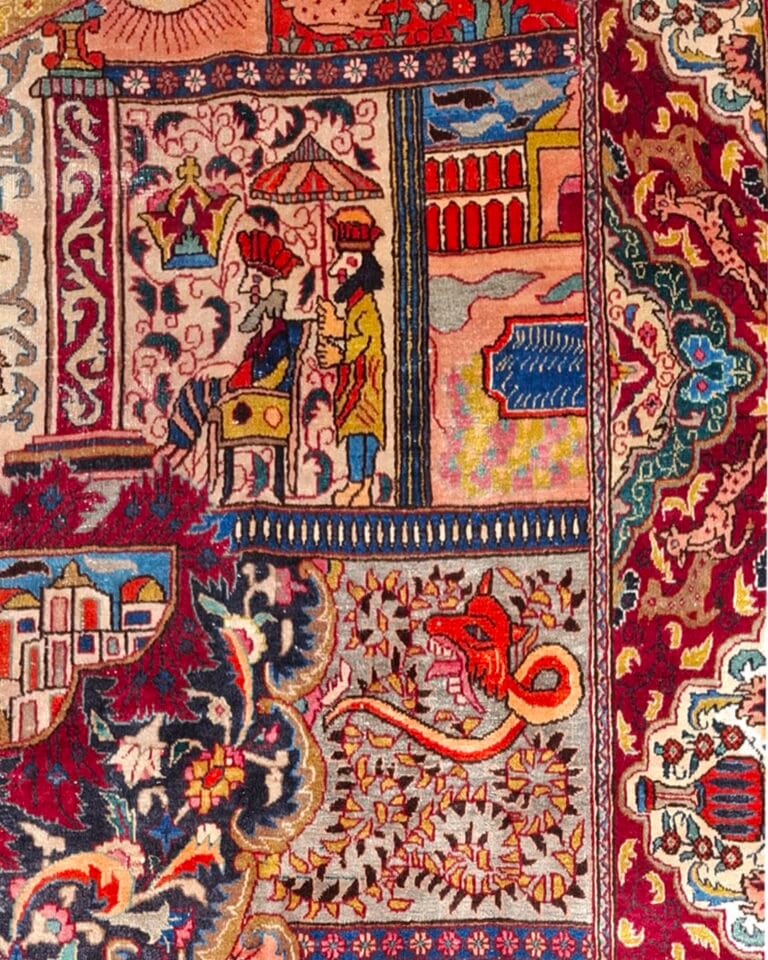
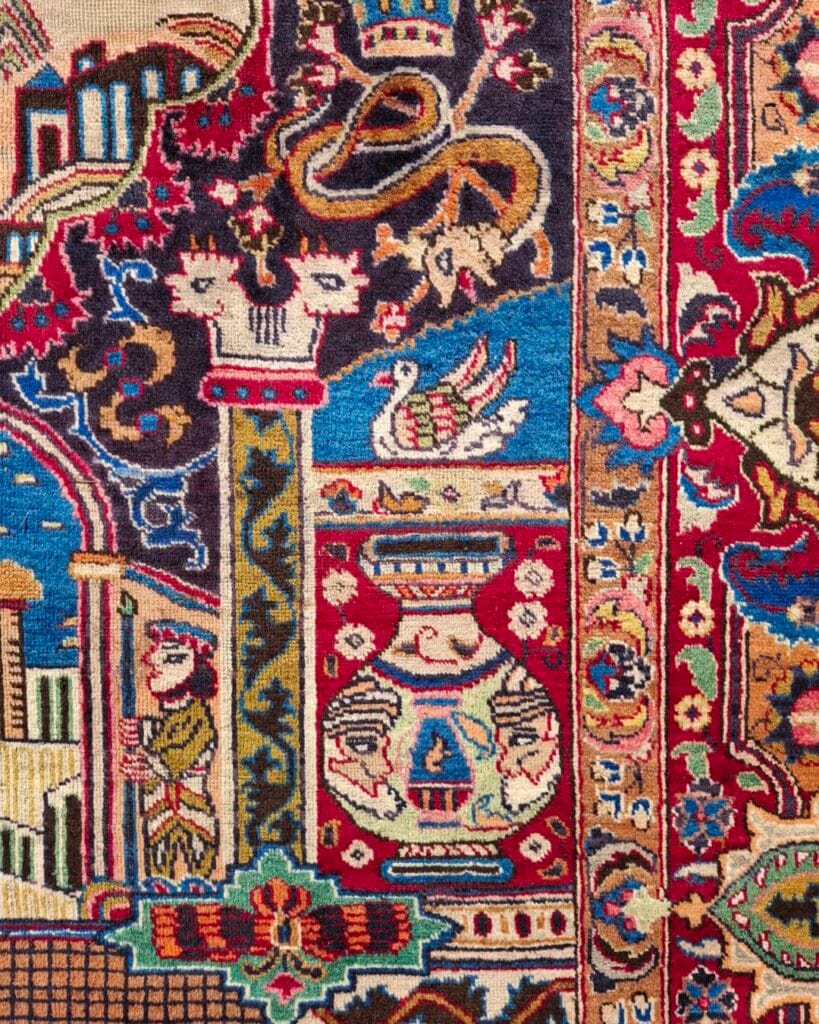
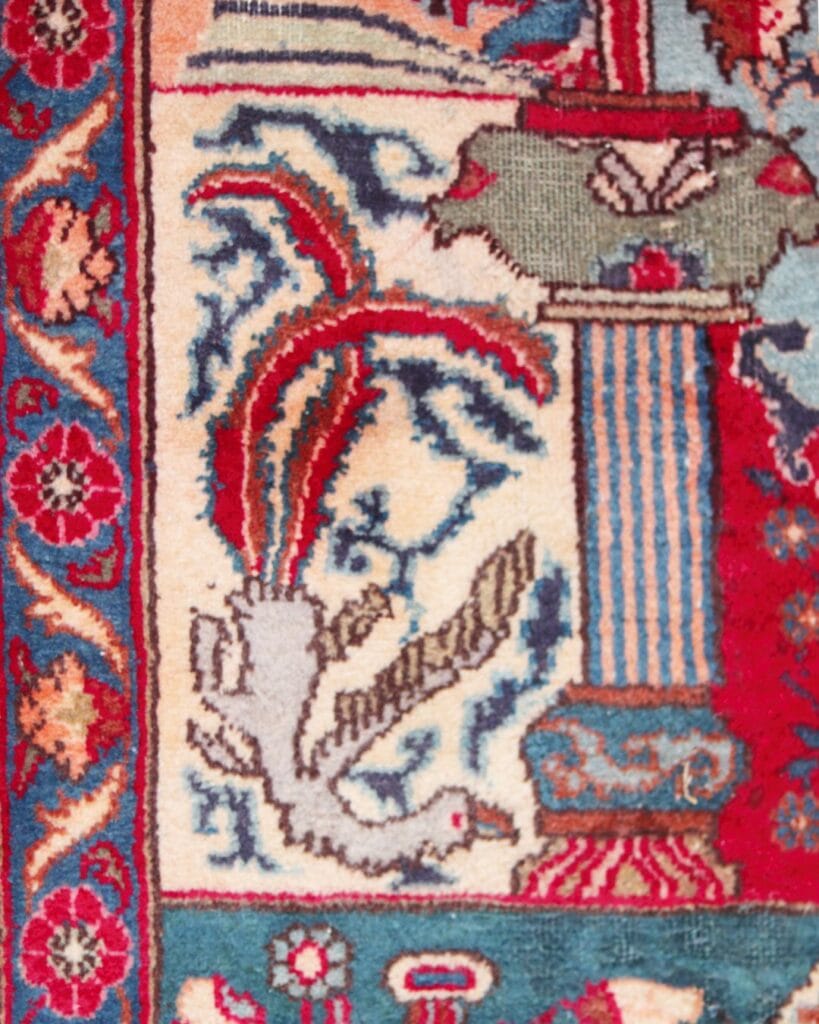
The carpets use a syncretic visual language. Symbols include the Zoroastrian Faravahar, the poetic Simurgh bird, Buddhist chatras (sacred umbrellas), Islamic Kufic script, and royal motifs like lions from Persepolis.
Designers sourced these motifs from ancient architecture, Sassanian rock reliefs, metalwork, coins, and manuscript paintings like the Shahnameh.
Thus, 19th-century Kashmar carpets modernize Persia’s ancient artistic heritage, weaving a millennia-old symbolic lexicon into a single Silk Road narrative.
Kashmar Persian carpets are the most interesting kind of Persian carpet, from a cultural history point of view.
The Kashmar pictorial carpets originate in Khorason province, a Silk Road thoroughfare. This melting pot blended many cultures and produced tradeable art products in ceramics, woodcraft and weaving.
In the carpet craft, the various histories, spiritual ideas and cultures from China, India, Arabia and the people of the Steppes were knotted together into new motifs and designs to be sold to the growing markets in Europe.
New ideas, new symbolic elements and a new artistic grammar resulted from the blending of these cultures into a viable commercial art product.
Khorasan, meaning “The Land of the Sun,” formed the heartland of ancient Persia, stretching between the Iranian plateau and Central Asia. This region served as a central thoroughfare for the Silk Road.
This network of trade routes facilitated exchanges of goods and culture. Caravans carried Buddhist monks, Zoroastrian priests, Hindu scholars, and Islamic mystics, who shared and assimilated new ideas, art, spiritual tenets, and goods.
During the classical period, Khorasan ranked among the Caliphate’s wealthiest provinces. This prosperity fueled a sophisticated art industry, whose surviving artifacts show how the region’s culture continuously redefined and reconstructed itself.
Local weavers absorbed this incredible fusion of cultures and religious influences, which they wove directly into their designs and motifs.
Consequently, the pictorial carpets from this area directly reflect this unique historical context, capturing the cultural integration of Zoroastrianism, Buddhism, Islam, and Hinduism.
The Kashmar pictorial carpet is a rare narrative textile woven in a key Silk Road region. It integrates the diverse histories, spiritual ideas, and cultures of the many societies that converged in Khorasan, using syncretic symbols that embody this fusion.
Khorasan’s geography fostered a cultural crossroads. The sustained contact between different societies there generated a syncretism of worldviews, which local artisans then expressed through a new artistic language. This language featured original symbolic elements and a unique stylistic signature.
For centuries, established conventions governed Persian carpet design. Weavers primarily used geometric patterns and specific floral motifs—such as the Herati (fish), Shah Abbas, and repeating boteh (paisley)—as decorative elements, with patterns often identifying a carpet’s region of origin.
The symbolic language of Kashmar carpets fundamentally shifted Persian design from abstract decoration toward figurative narrative, creating the pictorial carpet. Furthermore, many of the motifs within these pictorial designs appear exclusively in Kashmar carpets.
For centuries, established conventions defined Persian carpet design, favoring geometric patterns and specific floral motifs like the Herati (fish), Shah Abbas, and repeating boteh (paisley).
These region-specific motifs were abstract, not pictoral.
The emergence of the pictorial carpet as a significant genre in the late 19th and early 20th centuries broke notably from this tradition. Several historical factors drove this shift:
This evolution transformed carpets from decorative objects into vehicles for narrative. Artisans began depicting specific scenes and figures—including historical events, literary episodes from poets like Ferdowsi or Hafez, religious imagery, and royal portraits—using the loom as a storytelling canvas.
This deliberate move from abstract pattern to figurative representation is the defining characteristic of the pictorial carpets of the Kashmar genre.
The Syncretic Symbols: A Visual Language in Pictorial Kashmar Carpets
The motifs in pictorial Kashmar carpets constitute a visual language that expresses the syncretic history of the Silk Road. Common symbols and their origins include:
Faravahar: This symbol directly links to Zoroastrianism, the pre-Islamic religion of Persia. It represents the human soul’s journey toward enlightenment.
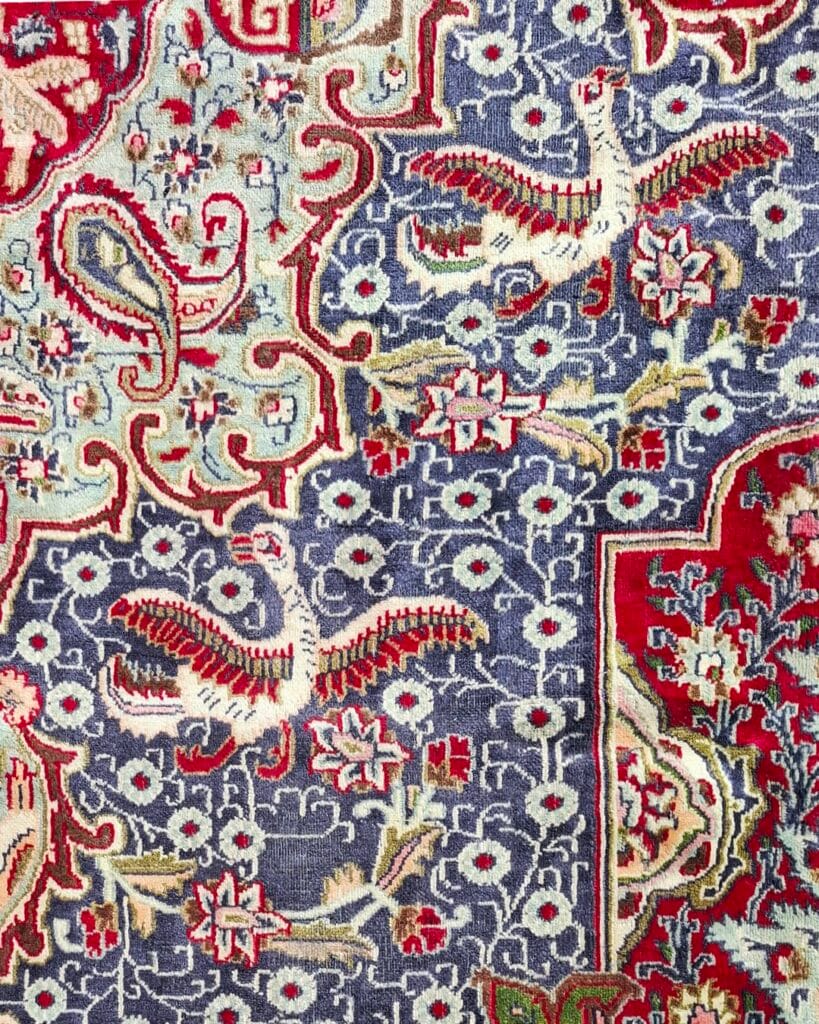
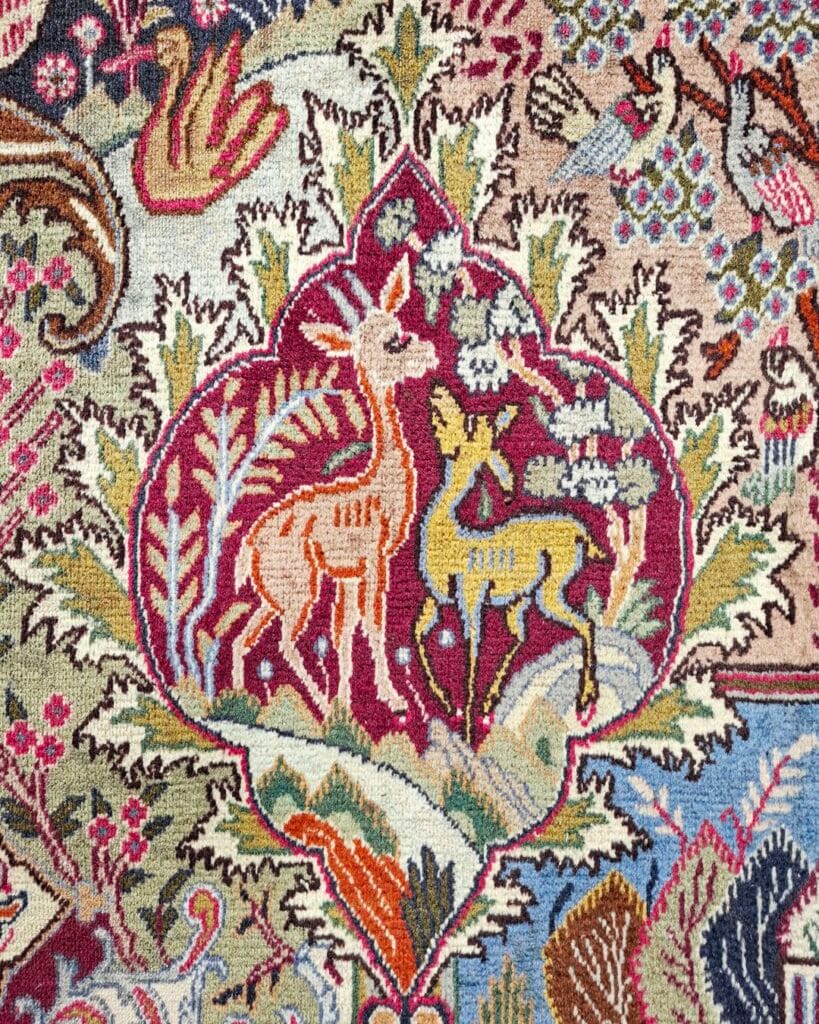
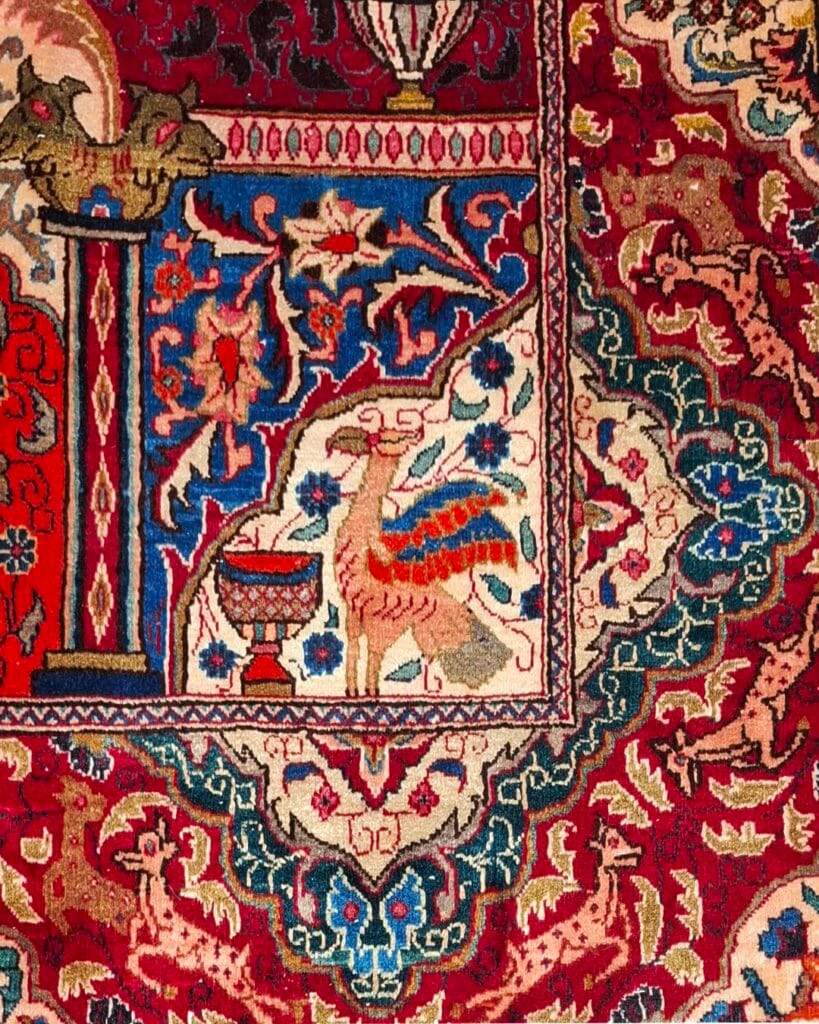
Simurgh & Huma Birds: These mythical birds derive from Persian epic poetry (like the Shahnameh). The Simurgh acts as a benevolent, wise protector. The Huma, a bird of fortune that never lands, symbolizes royalty and evanescence.
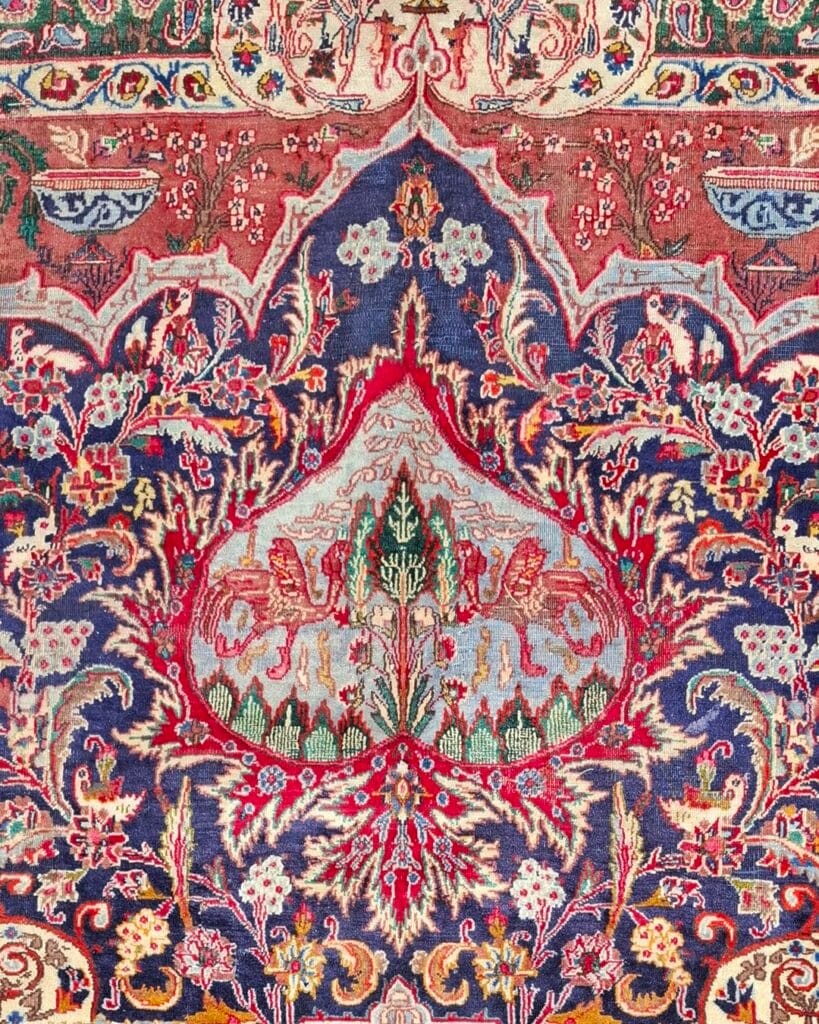
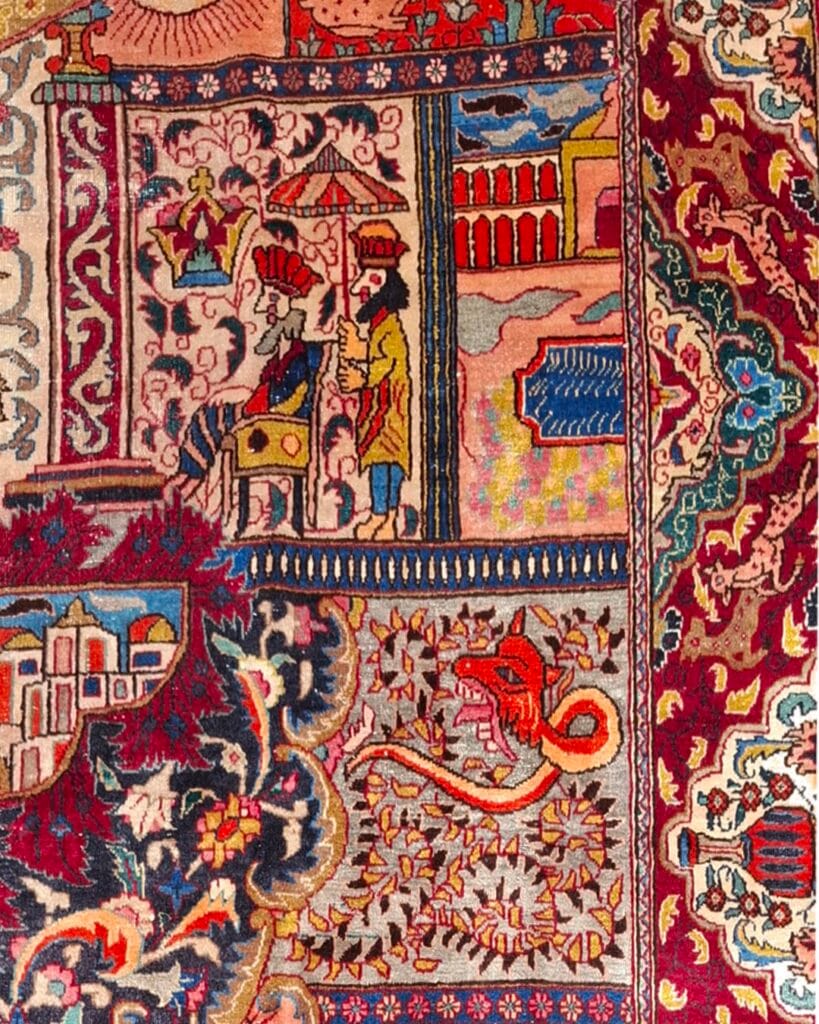
Dragons & Griffins: These composite creatures originate in ancient Persian myth and also appear, via Silk Road exchange, in the art of cultures farther east, such as China and Tibet.
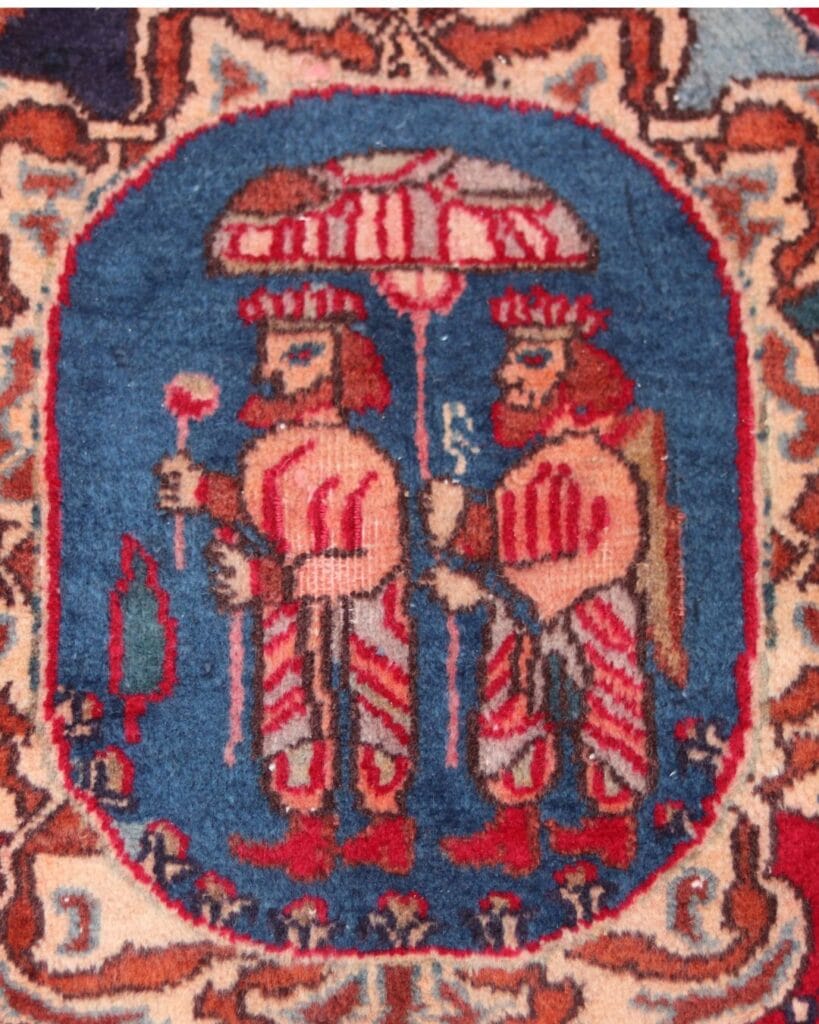
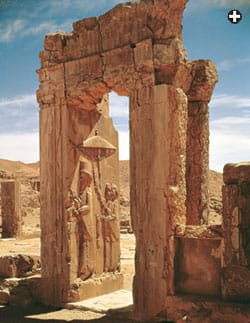
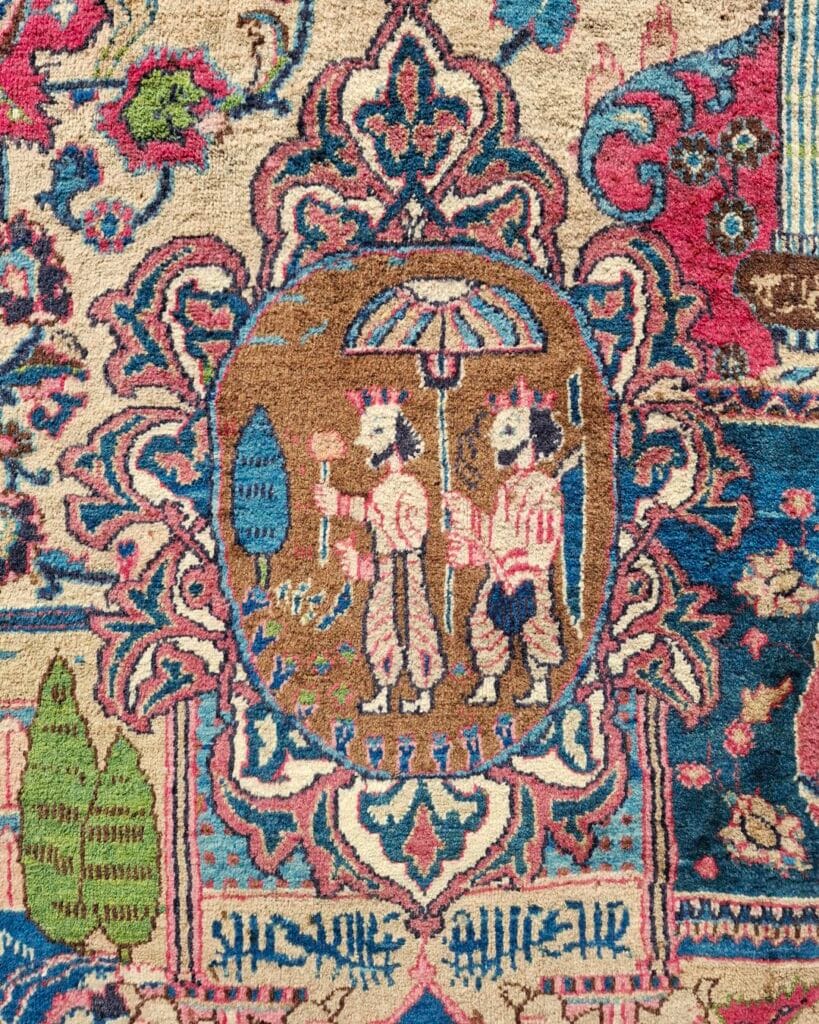
Buddhist Influences: The depiction of a “king protected by guards holding an umbrella” represents the Chatra, a sacred umbrella that symbolizes sovereignty and spiritual protection in Buddhist art. The “begging bowl” directly references the implements of Buddhist monks.
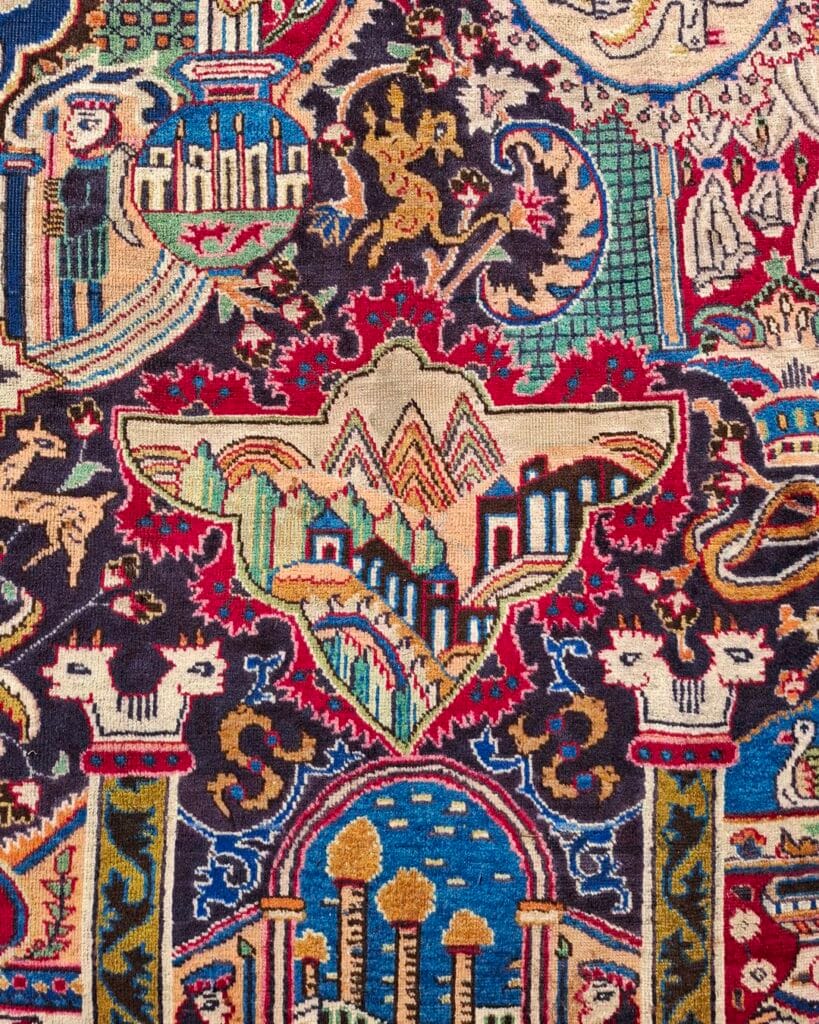
Islamic Art: Kufic script (often containing poetry or Qur’anic verses) and mosque imagery anchor the carpets in the Islamic era. The ubiquitous boteh (paisley) motif carries interpretations ranging from a Cypress tree (a Zoroastrian symbol of eternity) to a flame.
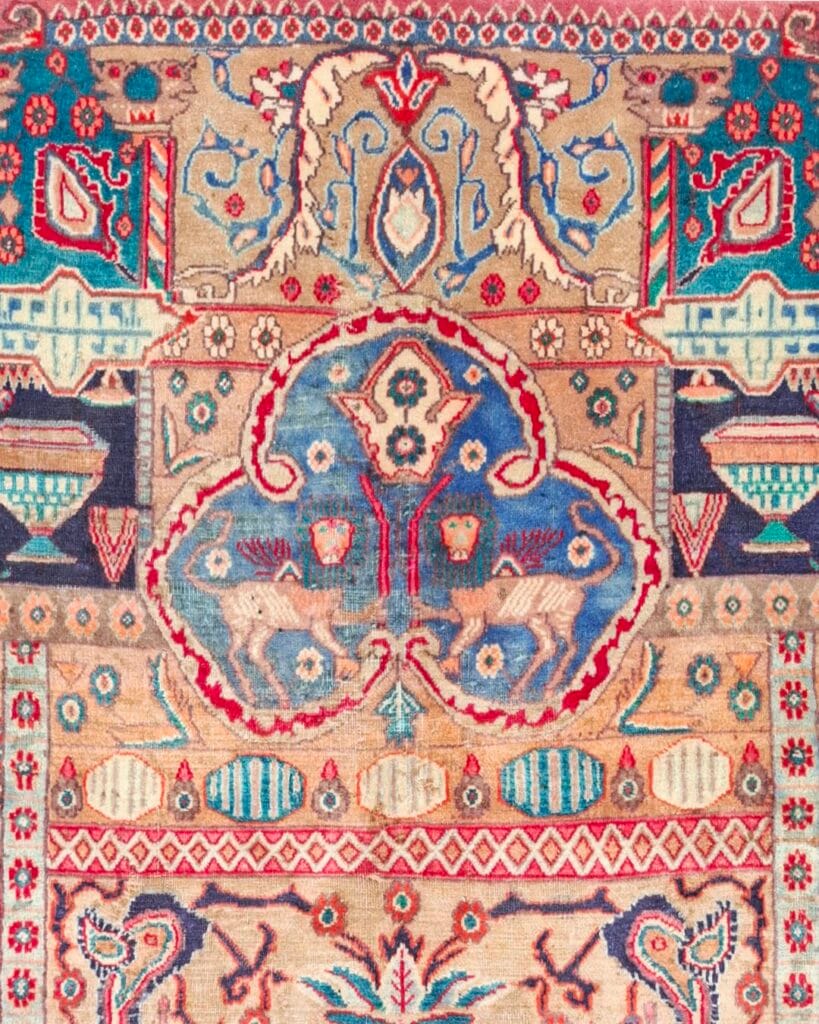
Royal & Ancient Persian Motifs: Crowns, chalices, lions, and relics from Persepolis connect the carpets directly to the glory of the Achaemenid and Sassanian Persian empires, a continual source of national pride.
In essence, a pictorial Kashmar carpet captures a Silk Road dialogue in wool and silk. It juxtaposes Zoroastrian and Buddhist symbols within the Islamic tradition of intricate craftsmanship.
Although the pictorial carpet genre emerged in the 19th century, it draws on a much older visual library. The weavers and designers of these carpets synthesized a national artistic heritage, mining a visual vocabulary from architecture, ceramics, textiles, and manuscripts. They re-contextualized ancient symbols within the newer format of the narrative carpet, creating a unique art form that was simultaneously modern and historical.
The primary sources for their symbols included the following:
1. Ancient Architecture & Rock Reliefs
Persepolis: The ruins of this Achaemenid capital (c. 550-330 BCE) provided motifs directly from its carved reliefs and sculptures, including lions, griffins, cypress trees, and figures in profile.
Sassanian Rock Reliefs (c. 224-651 CE): Reliefs at sites like Naqsh-e Rostam and Taq-e Bostan supplied models for royal imagery, such as equestrian scenes of kings, investiture ceremonies, and royal hunts.
2. Pre-Islamic Metalwork & Coinage
Sassanian Silverware and Achaemenid & Sassanian coinage offered a repertoire of iconic forms and regal iconography.
3. Manuscripts & Miniature Painting
Persian Miniature Painting: The centuries-old practice of illustrating literary works, especially Ferdowsi’s Shahnameh (The Book of Kings), provided ready-made compositions. Weavers translated these painted scenes from paper to wool, depicting the Simurgh with Zal and Rostam, royal battles and banquets, and the Huma bird.
4. Religious & Ceremonial Objects
Zoroastrian Artifacts, such as objects bearing the Faravahar symbol.
Buddhist Objects: The region’s artistic legacy of Buddhism, including the architectural form of the stupa and the ceremonial chatra (umbrella), persisted in local art and architecture, which 19th-century artists studied and incorporated.
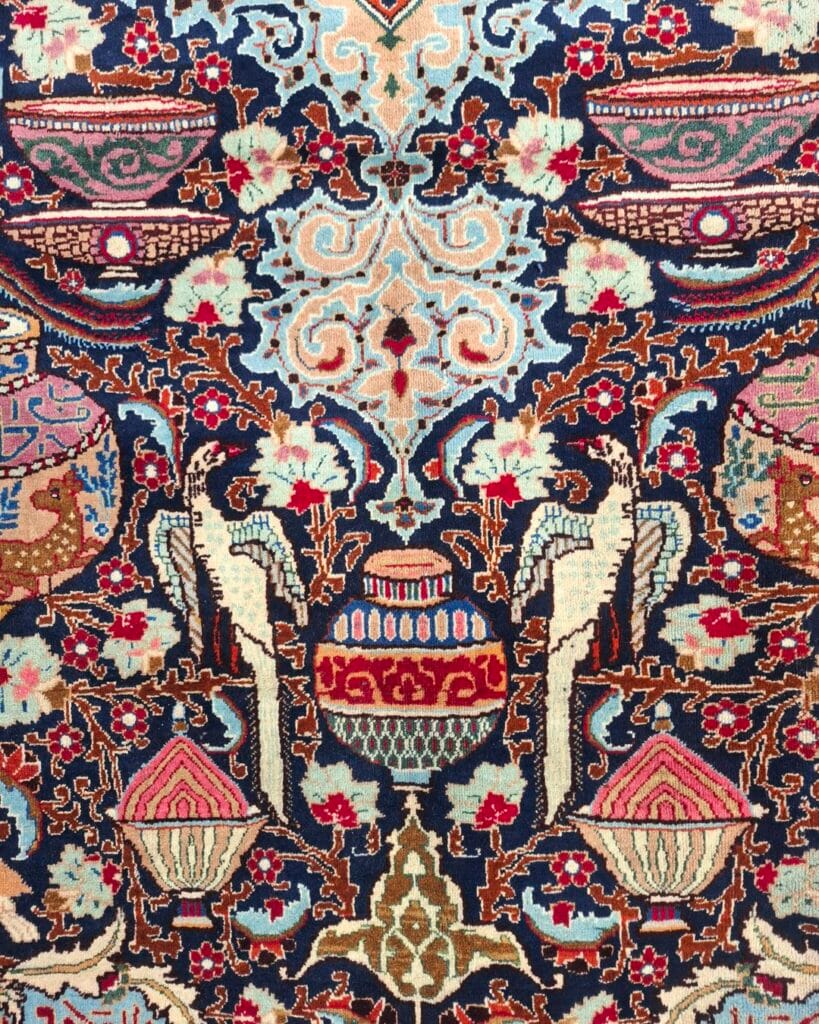
Medallion carpets from Khorasan feature unique motifs like the Vase of Plenty, begging bowls, and specific birds, which point to the region’s distinctive cultural history.
These Buddhist symbols appear centuries after Buddhism itself faded from the area, indicating a deep, localized cultural memory.
A factual breakdown explains this occurrence:
1. Khorasan Was a Major Center of Buddhism in Persia.
From the 2nd century BCE to as late as the 10th century CE, parts of Khorasan, particularly the city of Balkh (“Mother of Cities”), functioned as major centers of Buddhist learning and monastic life.
The Silk Road sustained this activity. Buddhist monks traveled this route, built monasteries (viharas), and produced art in the region, where Buddhism coexisted with Zoroastrianism and other beliefs for centuries.
While Islam became the dominant religion after the 7th-8th centuries, the artistic and cultural imprint of Buddhism persisted.
2. The Motifs Represent a Cultural and Artistic Legacy, Not a Religious One.
The 19th-century weavers were almost certainly Muslim and were not producing Buddhist devotional objects.
Instead, they employed a stylistic and symbolic vocabulary preserved in the region’s art for generations. These symbols had become part of the local visual language.
The begging bowl (patra) exemplifies this. Its specific form and association with asceticism and holiness were ingrained in the region’s artistic heritage. A Kashmar weaver incorporating it referenced a known symbol of piety and local history, not the active practice of Buddhism.
3. The “Vase of Plenty” and “Begging Bowl” Form a Deliberate Contrast.
This juxtaposition highlights the design’s sophistication:
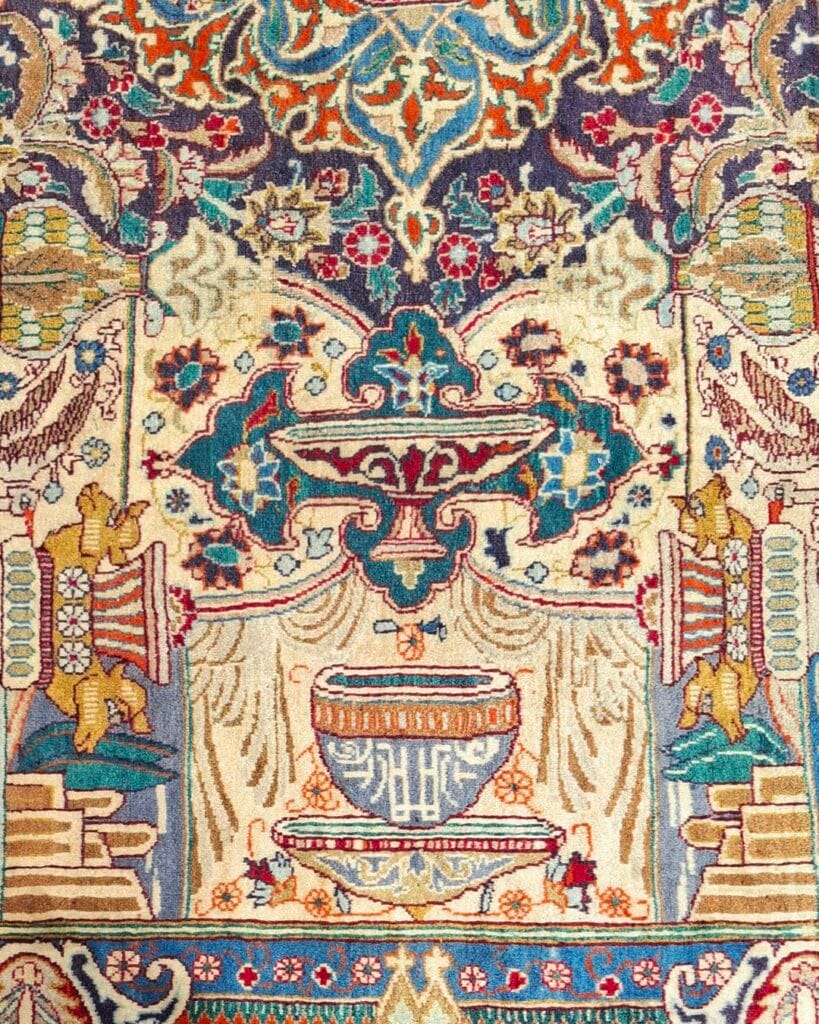
The Vase of Plenty (Anghuz-é Por), with its overflowing vegetation, is a Zoroastrian and Persian symbol of abundance, fertility, and eternal life.
The Begging Bowl is a Buddhist symbol of renunciation, simplicity, and detachment from material wealth.
By placing these two opposing symbols within the same carpet—often in a medallion format—the weavers created a complex philosophical statement. This composition balances worldly abundance with spiritual humility, a theme that resonates across the Zoroastrian, Islamic (Sufi), and Buddhist philosophies that all shaped Khorasan.
In summary, Khorasan carpets feature these specific motifs because the region accumulated layers of cultural influence.
The Buddhist symbols represent a direct artistic inheritance from its period as a Buddhist center.
Nineteenth-century weavers accessed this shared cultural memory, using ancient symbols to create carpets of deep philosophical and narrative depth, distinguishing them from the more purely decorative traditions of other regions.
The integration of Buddhist motifs into Khorasan’s Islamic carpets is rooted in a profound philosophical overlap between Sufi Islam and Buddhism. These symbols persisted not as foreign borrowings, but because they gave potent visual form to spiritual concepts shared by both traditions.
Shared Foundational Principles:
Motifs with Shared Symbolic Meaning:
The carpets are thus a physical meeting point for these convergent paths to enlightenment, where symbols resonate with universal spiritual truths.
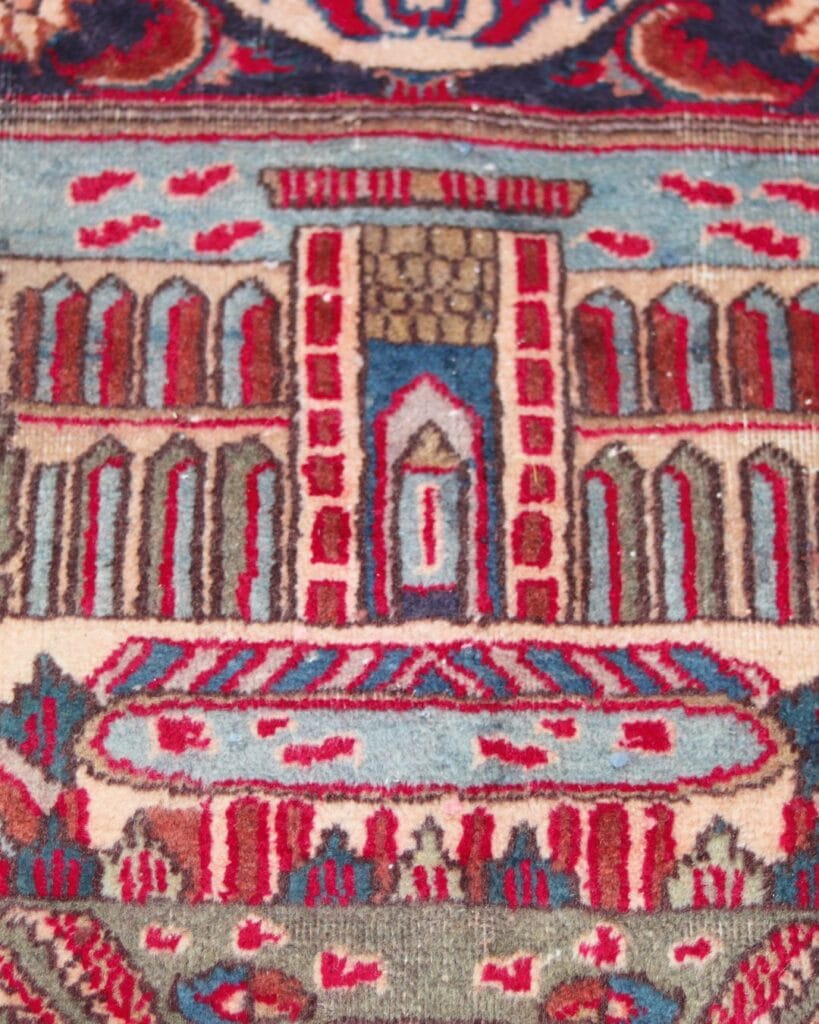
The depiction of mosques in Pictorial Kashmar carpets embodies a multi-layered practice, rooted in spiritual, social, and artistic traditions.
1. Spiritual Aspiration and Sanctuary
On a prayer carpet (sajjadeh), the woven mosque functions as a portable mihrab, orienting the faithful. More broadly, it symbolizes a holy sanctuary and the soul’s ultimate spiritual destination, aligning with the symbolism of motifs like the Simurgh on its journey.
2. Cultural and Religious Identity
As the historical heart of the community, the woven mosque declares Islamic identity and piety. During a period of modernization, its inclusion also performed an act of cultural preservation within an art form that incorporated pre-Islamic motifs.
3. Architectural Craftsmanship
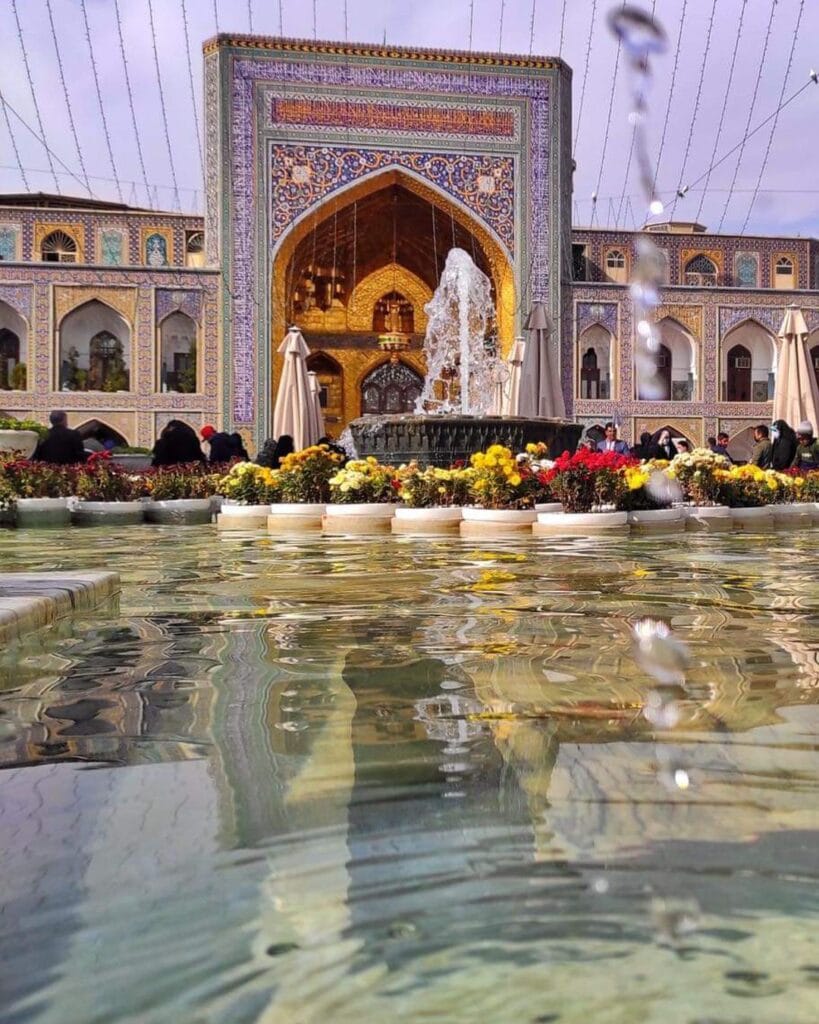
Weaving a mosque demonstrated a master weaver’s supreme skill. It required translating the grandeur of Persian architecture—domes, minarets, tilework, and calligraphy—into the demanding textile medium.
4. Narrative Storytelling
In carpets illustrating historical or poetic stories, the mosque often serves as the setting for pivotal events, such as the arrival of a saint or a key moment in a mystical journey.
5. A Unifying Vision
The mosque’s presence alongside pre-Islamic symbols (a Zoroastrian Faravahar, a Buddhist begging bowl) does not create a contradiction. Instead, it completes the “Silk Road conversation,” acting as a unifying frame that suggests these diverse spiritual paths find shared expression within Islamic, particularly Sufi, spirituality. The carpet presents a visual thesis on the unity of spiritual pursuit.
In these carpets, the mosque is more than a building; it is the heart and home of the spiritual narrative