
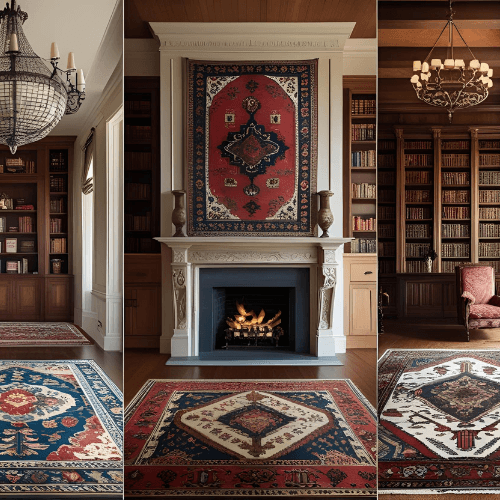
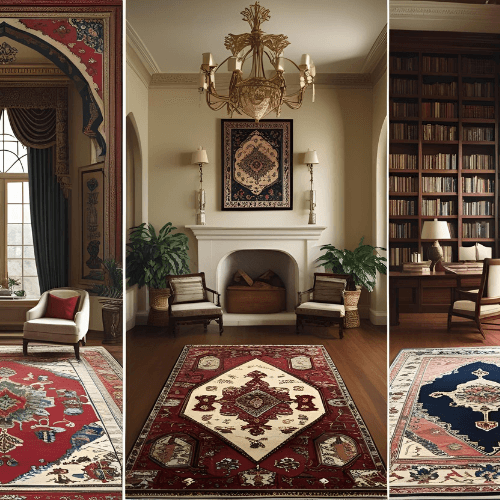
Persian carpets are more than floor coverings—they’re woven stories, rich in symbolism and artistry. Understanding Persian carpet design types helps you appreciate not only the beauty of the rug but also its cultural and regional significance. In this guide, we explore the most iconic Persian design types and the motifs that bring them to life.
The design of a Persian rug reflects the weaver’s heritage, the region where it was made, and the story it’s meant to tell. Whether crafted by a nomadic tribe or in a city workshop, each pattern carries meaning—ranging from spiritual protection to fertility, the natural world, or even historical narratives.
Medallion
All-Over (Repeating)
Found in Heriz, Bakhtiari, Bidjar
Garden Design
Pictorial
Panel
Tribal/Geometric
Herati: Fish surrounding a flower — symbolizes protection and water
Boteh: Paisley-like shape — symbolises fertility, eternity, and fire
Gul: Rosette or flower medallion — especially used in Turkoman tribal rugs
Cypress Tree: Symbol of life after death and endurance in Persian gardens
Mihrab: The prayer niche or arch seen in prayer rugs — symbolizes spiritual connection
Check your space and choose a rug size that fits. Standard options: 4×3m, 3.5×2.5m, 3×2m.
Open our catalogue to filter by size, colour, price, or design — or click a product heading to view full details and enquire.
Click 'Enquire' on any listing and fill in your contact details. We'll assist you directly.
View in Randburg by appointment, even on Sundays. Nationwide courier available.
Check your space and choose a rug size that fits. Standard options: 4×3m, 3.5×2.5m, 3×2m.
Open our catalogue to filter by size, colour, price, or design — or click a product heading to view full details and enquire.
Click 'Enquire' on any listing and fill in your contact details. We'll assist you directly.
View in Randburg by appointment, even on Sundays. Nationwide courier available.
Browse our curated collection of new and gently used Persian carpets, meticulously selected to meet the discerning tastes of our clientele.
info@persiancarpetsonline.co.za
Malanshof , Randburg , Johannesburg , South Africa
Copyright © 2026, Persian Carpets Online , All Right Reserved, Designed by Sugarbird Digital Marketing